

Showing posts with label economy. Show all posts
Showing posts with label economy. Show all posts
8:11 AM
7:55 AM
The road to the economy's recovery has been a long and winding one. For sure.
What we have to look at is the job picture. Frankly the overall job growth situation has been dismal. It could be worse, so we have that going for us. The addition of more jobs would be beneficial to several sectors of the U.S. economy including housing.
The remainder of 2014 has the pulse of the consumer in the mix. While I'm on that subject, August retail sales were reported earlier today as increasing by 0.6 percent after an upwardly revised 0.3 percent. July was previously reported to have been flat.
The core sales correspond mostly with the GDP, which increased 0.4 percent in August.
Reuters was a source for this entry.
What we have to look at is the job picture. Frankly the overall job growth situation has been dismal. It could be worse, so we have that going for us. The addition of more jobs would be beneficial to several sectors of the U.S. economy including housing.
The remainder of 2014 has the pulse of the consumer in the mix. While I'm on that subject, August retail sales were reported earlier today as increasing by 0.6 percent after an upwardly revised 0.3 percent. July was previously reported to have been flat.
The core sales correspond mostly with the GDP, which increased 0.4 percent in August.
Reuters was a source for this entry.
8:10 AM
The jobs report released this morning gave us significantly lower report than expected. This shows growth has slowed or even has halted. The report gave a number of 142,000 jobs added in August. The expectation number was at 225,000.
Labor force participation was little changed at 62.8% and that number has held steady since April.
At this writing the Dow is striving to hold off a fourth down day in-a-row.
This Forbes article was the source for this post.
Labor force participation was little changed at 62.8% and that number has held steady since April.
At this writing the Dow is striving to hold off a fourth down day in-a-row.
This Forbes article was the source for this post.
8:35 AM
The issue is the "American Dream" and optimism. Can we all really "make it"? Perhaps it's time to change our paradigm. John Oliver explains:
The wealth gap increased as, according to NBC Nightly News, the 1% had 19.3% of the income in 2013.Policies that benefit the few have been supported by the many. John Oliver says because of optimism. He calls optimism America's greatest quality. Could it also be our greatest downfall? America has a system where wealth is disbursed by a lottery of wealth. We have accepted it.
Here's the source of the story from Salon.com
The wealth gap increased as, according to NBC Nightly News, the 1% had 19.3% of the income in 2013.Policies that benefit the few have been supported by the many. John Oliver says because of optimism. He calls optimism America's greatest quality. Could it also be our greatest downfall? America has a system where wealth is disbursed by a lottery of wealth. We have accepted it.
Here's the source of the story from Salon.com
11:09 AM
There is intrigue. The unemployment rate stayed at 6.3% which has the Fed's attention. There is no certainty what this means for monetary policy.
A new system has come into focus. This is from economist Andrew Levin and is relayed on a post from businessinsider.com giving us a good view of what it's all about. Levin's info is quantitative and the Fed likes that data. The emphasis has been on wages.
The chart above is very interesting to me, since it also charts the underemployment gap. Wages are not definitively moving higher. This alone has me wondering if the Fed really expects a change in their policy for 2014. The middle of June will give us more of a handle on the Fed's tone.
A new system has come into focus. This is from economist Andrew Levin and is relayed on a post from businessinsider.com giving us a good view of what it's all about. Levin's info is quantitative and the Fed likes that data. The emphasis has been on wages.
 | ||||
| from Pandi/Columbia |
The chart above is very interesting to me, since it also charts the underemployment gap. Wages are not definitively moving higher. This alone has me wondering if the Fed really expects a change in their policy for 2014. The middle of June will give us more of a handle on the Fed's tone.
3:37 PM
The recession ended 5 years ago. Did you notice? GDP figures can be volatile, as we were reminded by several economists. In a zerohedge.com story by Tyler Durden, the economic pulse isn't good. There is always a silver lining in side every dark cloud.... right?
Some have noted weaker than expected Q1 2014 GDP will bring a stronger Q2 number. Keep that in the brainpan because that will be the silver lining.... if it happens. Tyler brings forth the notion of ignoring the hard data and relying on the Fed's balance sheet.
One central point is stagnating median incomes. There has been info pointing to this for about 5 years. Housing has been struggling in some areas of the country and are still feeling the effects of the recession. Smart Girl Politics asks, "What happened to the recovery?"
The positive spin on the economy continues as they point out in their article. One "spin" of note is that the U.S. economy contracted for the first time since 2011. This contraction shows how much fragility the economy has.
Some have noted weaker than expected Q1 2014 GDP will bring a stronger Q2 number. Keep that in the brainpan because that will be the silver lining.... if it happens. Tyler brings forth the notion of ignoring the hard data and relying on the Fed's balance sheet.
One central point is stagnating median incomes. There has been info pointing to this for about 5 years. Housing has been struggling in some areas of the country and are still feeling the effects of the recession. Smart Girl Politics asks, "What happened to the recovery?"
The positive spin on the economy continues as they point out in their article. One "spin" of note is that the U.S. economy contracted for the first time since 2011. This contraction shows how much fragility the economy has.
12:40 PM
Wages are rising, loan growth by commercial banks has picked up, but investment is depressed. Two outta three ain't bad. Hiring could be kicked into a higher gear. Recovery then growth, in that order, have been slow.... but upticks are here.
Read more from Business Insider.
Theweek.com has a story about using GDP as a measurement. Problems yes, but it's all we have. Intermediate goods are left out. Taken into consideration, the question has been asked if the economy is really bigger than it is.
Read the story from theweek.com.
Is there something afoot on the consumer side? Zerohedge.com has a story on quarterly sales and consumers falling flat. Current projections are a 2.5% revenue gain. The narrow channels on the radar can't be ignored.
Read the story from zerohedge.com
Solid ground or not, it's still a bit soft in the middle.
Read more from Business Insider.
Theweek.com has a story about using GDP as a measurement. Problems yes, but it's all we have. Intermediate goods are left out. Taken into consideration, the question has been asked if the economy is really bigger than it is.
Read the story from theweek.com.
Is there something afoot on the consumer side? Zerohedge.com has a story on quarterly sales and consumers falling flat. Current projections are a 2.5% revenue gain. The narrow channels on the radar can't be ignored.
Read the story from zerohedge.com
Solid ground or not, it's still a bit soft in the middle.
1:09 PM
A good article I came across has some good ammo on why the economic recovery isn't really happening. The recovery (if that is what you call it) is flat.
The Fed's efforts has injected money into the stock markets. Several analysts have stated since last summer that that's about all the Fed's QE policy has accomplished.
Here are a couple of items from list list of 37:
Why an Economy Grows and Why it Crashes
The Fed's efforts has injected money into the stock markets. Several analysts have stated since last summer that that's about all the Fed's QE policy has accomplished.
Here are a couple of items from list list of 37:
- The employment-population ratio has now been under 59 for 51 months in a row.
- Only about 47% of the adults in the U.S. have a full-time job.
Why an Economy Grows and Why it Crashes
8:14 AM
Ever wonder what the early warning signs are of a financial meltdown?

Here's some mentioned in a blog post I found:
- CNBC reports retailers had the worst holiday shopping season since 2008.
- Intel announced the elimination of 5,000 jobs this year.
- Venezuela devalued their currency by 40%
- Ukraine is rapidly coming apart at the seems
Tax Return Software and More
6:27 AM
 | ||
| click to enlarge |
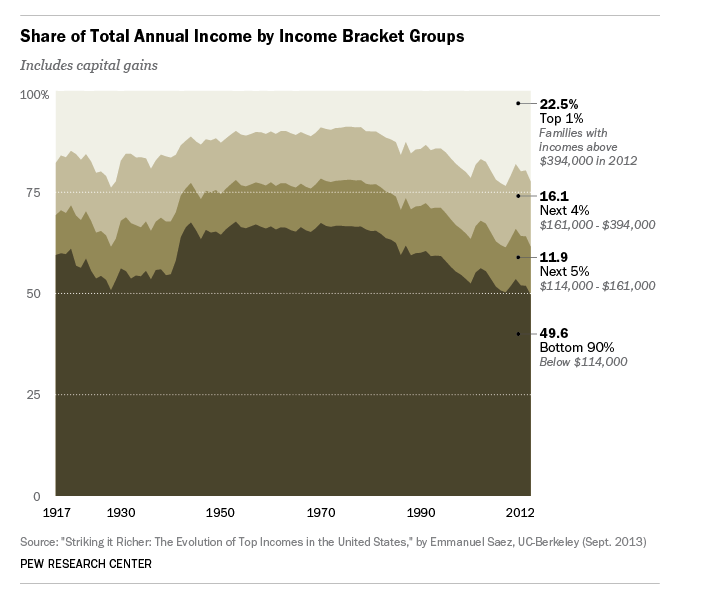
Pew Reasearch has released data on their inequality study. They have put together a "5 facts primer". Here are the 5 topics:
- By one measure, U.S. income inequality is the highest it’s been since 1928.
- The U.S. is more unequal than most of its developed-world peers.
- The black-white income gap in the U.S. has persisted.
- Americans are relatively unconcerned about the wide income gap between rich and poor.
- Wealth inequality is even greater than income inequality.
11:46 PM
In his 1841 work Extraordinary Popular Delusions and the Madness of
Crowds, Charles Mackay (1814-89) identified a common thread of
individual and collective idiocy running through such follies of the
past. These included alchemy, witchhunts, and crusades.
A clear implication of Mackay’s work was that all of these follies had been consigned to the past by intelligence, experience and enlightenment. But one folly remains alive and well. Financial bubbles. The past thirty years has given us the growth and bursting of the greatest financial bubble in history. This bubble confirmed the idiocy identified by Mackay. This 'money for nothing' lunacy has mired much of the world in debt from which there is no escape.

Perhaps the most truly remarkable feature of this "super-cycle" was that it endured for so long in defiance of all logic or common sense. Individuals in their millions believed that property prices could only ever increase, such that either borrowing against equity (by taking on invariably-expensive credit) or spending it (through equity release) was a safe, rational and even normal way to behave. Former Federal Reserve boss Alan Greenspan has been ridiculed for believing that banks would always act in the best interests of their shareholders, and that the market would sort everything out in a benign way. But regulators more generally bent over backwards to ignore the most obvious warning signs, such as escalating property price-to-incomes ratios, soaring levels of debt-to-GDP, and such obviously-abusive practices as sub-prime mortgages. Debt escalation was making it self-evident that the apparent expansion in the economy was neither more nor less than the simple spending of borrowed money.
No other major economy got it quite as wrong as Britain under Gordon Brown, but much the same was happening across the Western world, most notably in those countries which followed the disastrous Anglo-American philosophy of “light-touch” financial regulation.
Where the Western countries were concerned, was that they reduced their production without making corresponding reductions in their consumption. Corporations’ outsourcing of production to emerging economies boosted their earnings (and, consequently, the incomes of the minority at the very top) whilst hollowing out their domestic economies through the export of skilled jobs.
At constant (2011) values, consumption by Americans increased by $6,500bn between 1981 and 2011, whilst consumption on their behalf by the government rose by a further $1,700bn, but the combined output of the manufacturing, construction, agricultural and extractive industries grew by barely $600bn. At less than $200bn in 2011, net exports of services did almost nothing to bridge the chasm between consumption and production. Between 1981 and 2011, and again expressed at constant values, American indebtedness soared from $11 trillion to almost $54 trillion. Fundamentally, what had happened here was that skilled, well-paid jobs had been exported, consumption had increased, and ever-greater quantities of debt had been used to fill the gap. This was, by any definition, unsustainable.
At the same time, there is no real evidence that the economy is recovering from what is already a more prolonged slump than the Great Depression of the 1930s. We are now more than four years on from the banking crisis and, under anything approaching normal conditions, there should have been a return to economic expansion by now. Governments have tried almost everything, from prolonged near-zero interest rates and stimulus expenditures to the creation of money on a gigantic scale. These tools have worked in the past, and the fact that, this time, they manifestly are not working should tell us that something profoundly different is going on.
Beyond visibility and culpability, the two big questions which need to be addressed are ‘how bad can it get?’ and ‘is there anything that we can do about it?’ Of these, the first question hardly needs an answer, since the implications seem self-evident. In terms of solutions, the first imperative is surely a cultural change away from instant gratification, a change which, if it is not adopted willingly, will be enforced upon society anyway by the reversal of economic growth.
A clear implication of Mackay’s work was that all of these follies had been consigned to the past by intelligence, experience and enlightenment. But one folly remains alive and well. Financial bubbles. The past thirty years has given us the growth and bursting of the greatest financial bubble in history. This bubble confirmed the idiocy identified by Mackay. This 'money for nothing' lunacy has mired much of the world in debt from which there is no escape.

Perhaps the most truly remarkable feature of this "super-cycle" was that it endured for so long in defiance of all logic or common sense. Individuals in their millions believed that property prices could only ever increase, such that either borrowing against equity (by taking on invariably-expensive credit) or spending it (through equity release) was a safe, rational and even normal way to behave. Former Federal Reserve boss Alan Greenspan has been ridiculed for believing that banks would always act in the best interests of their shareholders, and that the market would sort everything out in a benign way. But regulators more generally bent over backwards to ignore the most obvious warning signs, such as escalating property price-to-incomes ratios, soaring levels of debt-to-GDP, and such obviously-abusive practices as sub-prime mortgages. Debt escalation was making it self-evident that the apparent expansion in the economy was neither more nor less than the simple spending of borrowed money.
 | |||
| click to enlarge |
No other major economy got it quite as wrong as Britain under Gordon Brown, but much the same was happening across the Western world, most notably in those countries which followed the disastrous Anglo-American philosophy of “light-touch” financial regulation.
Where the Western countries were concerned, was that they reduced their production without making corresponding reductions in their consumption. Corporations’ outsourcing of production to emerging economies boosted their earnings (and, consequently, the incomes of the minority at the very top) whilst hollowing out their domestic economies through the export of skilled jobs.
At constant (2011) values, consumption by Americans increased by $6,500bn between 1981 and 2011, whilst consumption on their behalf by the government rose by a further $1,700bn, but the combined output of the manufacturing, construction, agricultural and extractive industries grew by barely $600bn. At less than $200bn in 2011, net exports of services did almost nothing to bridge the chasm between consumption and production. Between 1981 and 2011, and again expressed at constant values, American indebtedness soared from $11 trillion to almost $54 trillion. Fundamentally, what had happened here was that skilled, well-paid jobs had been exported, consumption had increased, and ever-greater quantities of debt had been used to fill the gap. This was, by any definition, unsustainable.
At the same time, there is no real evidence that the economy is recovering from what is already a more prolonged slump than the Great Depression of the 1930s. We are now more than four years on from the banking crisis and, under anything approaching normal conditions, there should have been a return to economic expansion by now. Governments have tried almost everything, from prolonged near-zero interest rates and stimulus expenditures to the creation of money on a gigantic scale. These tools have worked in the past, and the fact that, this time, they manifestly are not working should tell us that something profoundly different is going on.
Beyond visibility and culpability, the two big questions which need to be addressed are ‘how bad can it get?’ and ‘is there anything that we can do about it?’ Of these, the first question hardly needs an answer, since the implications seem self-evident. In terms of solutions, the first imperative is surely a cultural change away from instant gratification, a change which, if it is not adopted willingly, will be enforced upon society anyway by the reversal of economic growth.
6:56 AM
The global economy had a pretty good October. Resilience was reflected. This despite a government shutdown in the United States. Even retail reports in the U.S. were good for October.
The November "so far" looks shaky. Manufacturing missed expectations. This signals a deceleration in growth. Any improvement was largely confined to Germany. The PMI there notched up the best growth, according to Markit economist Chris Williamson.
Growth outside France and Germany slowed to near stagnation. GDP could fall in the fourth quarter.
The November "so far" looks shaky. Manufacturing missed expectations. This signals a deceleration in growth. Any improvement was largely confined to Germany. The PMI there notched up the best growth, according to Markit economist Chris Williamson.
Growth outside France and Germany slowed to near stagnation. GDP could fall in the fourth quarter.
6:25 PM
The American economy is proving a bit tricky at the moment. Housing markets continue to strengthen, and the labor market is maintaining its plodding but stable rate of improvement. One wonders to what extent equity prices reflect global, rather than domestic, factors. Markets got a little nervous about recovery in the spring. Markets anticipate faster Fed tightening, but that's mostly because the recovery has sturdier legs. America seems to be getting much more real growth relative to inflation than it did earlier in the recovery.
Alternatively, one could say that markets got nervous about recovery in the spring, became more confident from early May, but have since become very worried about too-rapid Fed tightening.
Talk of "financial stability concerns" and QE tapering has come even as the global economy has looked shakier. There is no cause, whatsoever, for the Fed to begin tightening. On the contrary, the Fed has every reason to keep the pedal to the metal.
Better American fundamentals should make monetary policy more effective and give the Fed more room to ease, but the Fed instead seems to want to use them as an excuse to tighten. That's not good.
Alternatively, one could say that markets got nervous about recovery in the spring, became more confident from early May, but have since become very worried about too-rapid Fed tightening.
Talk of "financial stability concerns" and QE tapering has come even as the global economy has looked shakier. There is no cause, whatsoever, for the Fed to begin tightening. On the contrary, the Fed has every reason to keep the pedal to the metal.
Better American fundamentals should make monetary policy more effective and give the Fed more room to ease, but the Fed instead seems to want to use them as an excuse to tighten. That's not good.
10:29 PM
U.S. markets are higher and less volatile. The economy still feels weak.
Barclays analysts released their new Global Outlook - stating to stay in stocks. Ben Bernanke, Federal Reserve chairman, has said that stock market highs are not a new bubble. He said stocks should be high because companies are booking strong profits.
The economic confidence has not been boosted with the stock market numbers. Does the global expansion have staying power? The Fed bond buying hasn't hurt, keeping interest rates low.
Are we sleepwalking? Maybe.
One item to look at is volatility and it has been low as of late, indicating steady stock price increases and a recovering economy. The Bernanke approach will continue. He said low interest rates in advanced nations benefit the world economy.
Volatility will not remain low. Will value producing profits remain high? That depends. More chapters of the long-term debt purchases by the Fed have to be written.
Source posts: How To Square the Market Bernanke Says Easing by Advanced Nations Helps
Barclays analysts released their new Global Outlook - stating to stay in stocks. Ben Bernanke, Federal Reserve chairman, has said that stock market highs are not a new bubble. He said stocks should be high because companies are booking strong profits.
The economic confidence has not been boosted with the stock market numbers. Does the global expansion have staying power? The Fed bond buying hasn't hurt, keeping interest rates low.
Are we sleepwalking? Maybe.
One item to look at is volatility and it has been low as of late, indicating steady stock price increases and a recovering economy. The Bernanke approach will continue. He said low interest rates in advanced nations benefit the world economy.
Volatility will not remain low. Will value producing profits remain high? That depends. More chapters of the long-term debt purchases by the Fed have to be written.
Source posts: How To Square the Market Bernanke Says Easing by Advanced Nations Helps
8:48 PM
The stock market's gains seem emotional to me. I know optimism is good. "Think positive" is a popular theme. We are positive going into a new year. We should be. Our journey through an ever-changing economic landscape is just beginning. Not every dollar going through our economy goes through Wall Street. But the Wall Street click has a good pulse on what consumers are doing. The market optimism has gained after the fiscal cliff drama has closed.
But what is really coming down the middle-class economy staircase?
We are going to be taxed more. The employee portion of Social Security tax withholding goes up to 6.2% from 4.2% on January 1, 2013. Employers have until February 15th to make the change from the previous rate, but the IRS bulletin on the topic instructs employers to make up any difference due from late adoption by March 31, 2013.
Approximately 79.1% of all U.S. households make less than $100,000 and are therefore subject to the entire impact of the Social Security tax. How much less will these households be taking home? Assuming a household makes $50,000 per year, that's $1,000.
Companies that rely on the middle-class consumer are going to face new challenges. However these challenges are going to exhibited in the market when they hit home, not before. After all, we're having too good a time.
But what is really coming down the middle-class economy staircase?
We are going to be taxed more. The employee portion of Social Security tax withholding goes up to 6.2% from 4.2% on January 1, 2013. Employers have until February 15th to make the change from the previous rate, but the IRS bulletin on the topic instructs employers to make up any difference due from late adoption by March 31, 2013.
Approximately 79.1% of all U.S. households make less than $100,000 and are therefore subject to the entire impact of the Social Security tax. How much less will these households be taking home? Assuming a household makes $50,000 per year, that's $1,000.
Companies that rely on the middle-class consumer are going to face new challenges. However these challenges are going to exhibited in the market when they hit home, not before. After all, we're having too good a time.
8:49 PM

High frequency. That's how I describe the market economy these days. We have to be on a whole new high frequency to keep up with what's going on. Or at least I'd like to think so. We have had quite a bit of information to digest. With Quantative Easing in place with the Fed buying mortgage backed securities at a furious pace, which will keep interest rates low; perhaps as far out as 2016, giving investors more incentive for dividend paying stocks. ETF's are also a big product now (no more stock picking).
What will Treasuries be like in one year? Flatlined? Well, maybe. The demand for them surely can't be increasing. Someone must know something I don't. Well.... yeah.
The S&P 500 has had a good three-year run. Throughout it all.... fiscal cliff, etc., the S&P has been a leader as far as market barometers go.
The economy still has a demand problem.

Labor share of income hit an all-time low in 2012. Corporate investors reaped nice gains as the labor market stays weak. The Retail ETF (XRT) beat the S&P 500, while the Homebuilders ETF (XHB) was the cream of the crop.
And all of a sudden housing is back. Thank you Ben! The Fed move is tying more to housing than what I had expected. With that...........

expect housing to continue the recovery.... watch home affordability. And continued labor market woes. Recovering labor yes, but at a slow pace.
The central banker remains at the forefront around the globe. Bernanke really wants the world to jump on board his program for more bond buying. Will the foreign central banks also but mortgage backed securities. Will they invest in our housing? They just might.
That should ease unemployment. But what about inflation? Are we against the inflation clock? The Fed does not expect inflation to go above 2% at all. Someone, somewhere has to be shaking their head and wondering what the Fed is taking. It really can't be a dose of reality, can it?
I feel the Fed has told the world that we are all in this together. Will all the players come to the table and play the Fed game? We shall see.
34 charts from theatlantic.com was used as a source story.
8:13 PM
The markets are broken. So says Chris Martenson of Peak Prosperity. Because they are not sending any clear signals anymore. Speculators are now the majority in the market. Not good. Sure has been a swing from the investor type. Mr. Martenson went on to write that nothing can be reasonably prices when the central banker misprices money and buys up everything related to bonds. Nothing can be reasonably priced.
What we have is a printing money out of thin air scenario. This might as well be called QE4. It is to act as both monetary and fiscal stimulus. The main goal is to provide economic activity, especially home building. The goal is to reduce the unemployment rate.
The Fed is now in the business of funding nearly 100% of all new government spending in 2013. As it does so another $1 trillion will be pumped into the economy. Inflation has to come into play with this mix.
Benanke said the Fed policy is tied to the unemployment rate. We could have a very long wait for the stimulus to end. The participation rate comes into play like it never has before. Conflicting numbers to be sure. As more people leave the labor force the participation rate goes down so does the unemployment rate. When more jobs are created the unemployment rate goes down too.
This latest QE effort will be with for 2 to 3 years according to Martenson. The Fed is likely to add another $3-4 trillion to its balance sheet. That's 300 - 400 % more money in the next year than was created in the first 200 years after the Declaration of Independence.
The one item to watch is inflation. Can the Fed keep it up? We'll see.
Link to the source story.
What we have is a printing money out of thin air scenario. This might as well be called QE4. It is to act as both monetary and fiscal stimulus. The main goal is to provide economic activity, especially home building. The goal is to reduce the unemployment rate.
The Fed is now in the business of funding nearly 100% of all new government spending in 2013. As it does so another $1 trillion will be pumped into the economy. Inflation has to come into play with this mix.
Benanke said the Fed policy is tied to the unemployment rate. We could have a very long wait for the stimulus to end. The participation rate comes into play like it never has before. Conflicting numbers to be sure. As more people leave the labor force the participation rate goes down so does the unemployment rate. When more jobs are created the unemployment rate goes down too.
This latest QE effort will be with for 2 to 3 years according to Martenson. The Fed is likely to add another $3-4 trillion to its balance sheet. That's 300 - 400 % more money in the next year than was created in the first 200 years after the Declaration of Independence.
The one item to watch is inflation. Can the Fed keep it up? We'll see.
Link to the source story.
8:12 AM
A coalition has been formed to put an end to the fiscal cliff. This includes Henry Kissinger and Jame Baker. Both with Secretary of State credentials. Deficit reduction was a key in there message.
Link to the story:
15 Leaders Urge end to Fiscal Cliff
Leaders want spending under control.
Link to the story:
15 Leaders Urge end to Fiscal Cliff
Leaders want spending under control.
6:30 AM
We hear much about consumer confidence. Have you ever thought of merchant confidence? The businesses that produce the jobs of Main Street and keep local economies humming are very important. We think perhaps too big at times. That's easy to do. The media has much to do with that attitude.
The MerchantCircle Merchant Confidence Index Survey was released for Q2 back in June and I wanted to share these results. I just discovered this blog entry.
A summary of mine has respondents seeing hiring go up just a bit and overall revenues to remain mostly the same. My "instant look" saw confidence vastly unchanged. These merchants are positive. They frankly are to be commended for their determination and bright outlook.
Most survey respondents did NOT use Facebook ads. This was a surprise to me. Since the survey was responded to online by merchants who are Internet active, as I'll call them, I would have guessed that they were using Facebook ads. The Social Media promotional folks have me thinking that businesses are running with Social Media resources constantly. I am in a re-think on this subject. Most respondents did NOT get new customers with Facebook ads. Has Social Media got us thinking "too big" and not thinking of details that keep business going?
The MerchantCircle Merchant Confidence Index Survey was released for Q2 back in June and I wanted to share these results. I just discovered this blog entry.
A summary of mine has respondents seeing hiring go up just a bit and overall revenues to remain mostly the same. My "instant look" saw confidence vastly unchanged. These merchants are positive. They frankly are to be commended for their determination and bright outlook.
Most survey respondents did NOT use Facebook ads. This was a surprise to me. Since the survey was responded to online by merchants who are Internet active, as I'll call them, I would have guessed that they were using Facebook ads. The Social Media promotional folks have me thinking that businesses are running with Social Media resources constantly. I am in a re-think on this subject. Most respondents did NOT get new customers with Facebook ads. Has Social Media got us thinking "too big" and not thinking of details that keep business going?
9:17 AM
With Labor Day we have the opportunity to recognize the importance of the approximately 155 million working men and women in this country who keep our economy chugging along. Times have been so up and down throughout the many sectors of our economy. We have seen jobs leave this nation and go to other countries. We've seen the energy sector frankly take in mountains of money. We've seen the housing sector take a tumble. When will the ups and downs like we have seen end? With the global economy, the ups and downs are more prevalent. I've read various articles about how the economy here in the U.S. is self-healing, but how do we know when the hurt is over. Well, that's easy.....when people are going back to work and staying at work. That's how we know. Service sector jobs also increase.
How is Illinois faring? In the manufacturing sector, the Manufacturers' News, Inc. directory of 2008, Illinois lost 14,357 manufacturing jobs and 425 manufacturers since November 2006. Manufacturers' News reports Illinois is home to 21,503 manufacturers employing 935,032 workers. Illinois ranks 3rd in the nation for number of manufacturing plants and fourth for industrial employment, accounting for 20% of the Midwest's manufacturers and 17% of the region's jobs. MNI surveys manufacturers of all sizes, including small companies.
One way to see how Illinois is doing, is the University of Illinois flash index. The index for August shows that the economy is in a slowdown in growth, just as a slowdown has been seen nationally. There is also concern that a slowing world economy along with the rebounding dollar will slow export growth.
How is Illinois faring? In the manufacturing sector, the Manufacturers' News, Inc. directory of 2008, Illinois lost 14,357 manufacturing jobs and 425 manufacturers since November 2006. Manufacturers' News reports Illinois is home to 21,503 manufacturers employing 935,032 workers. Illinois ranks 3rd in the nation for number of manufacturing plants and fourth for industrial employment, accounting for 20% of the Midwest's manufacturers and 17% of the region's jobs. MNI surveys manufacturers of all sizes, including small companies.
One way to see how Illinois is doing, is the University of Illinois flash index. The index for August shows that the economy is in a slowdown in growth, just as a slowdown has been seen nationally. There is also concern that a slowing world economy along with the rebounding dollar will slow export growth.