

Showing posts with label income. Show all posts
Showing posts with label income. Show all posts
6:27 AM
 | ||
| click to enlarge |
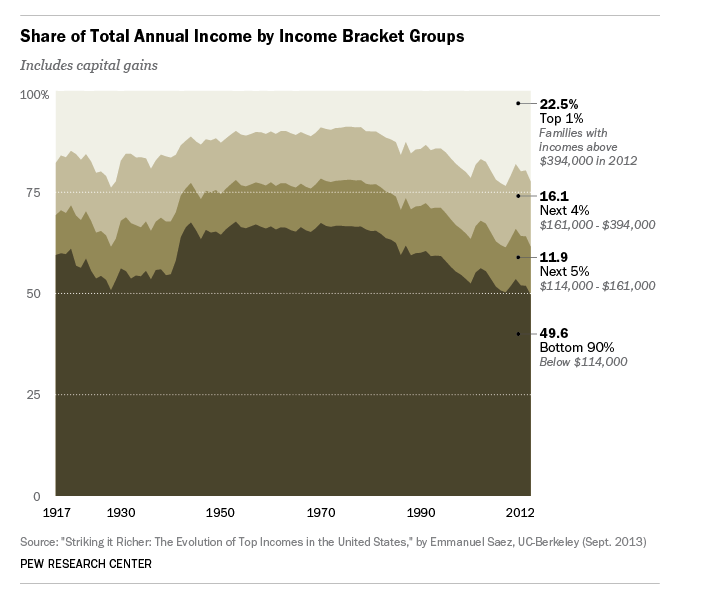
Pew Reasearch has released data on their inequality study. They have put together a "5 facts primer". Here are the 5 topics:
- By one measure, U.S. income inequality is the highest it’s been since 1928.
- The U.S. is more unequal than most of its developed-world peers.
- The black-white income gap in the U.S. has persisted.
- Americans are relatively unconcerned about the wide income gap between rich and poor.
- Wealth inequality is even greater than income inequality.
9:53 PM
Expansionary monetary policy, which lowers interest rates and eases credit, can be used to fight unemployment and economic recession. Policy makers around the world have put this practice in place. The "race to the bottom" for global interest rates is on.
Low interest rates should help increase consumer spending. But lower rates could be translated as damage limitation rather than growth promotion. Balance sheets are strong and cash is piling up. Job creation has to come from the corporate sector. However corporations are not on a hiring binge.
Corporate hiring caution is coming from economic uncertainty. One item in that category is the fiscal cliff. Fed policy has pushed interest rates to all-time lows. Dividend yields are now very attractive. Dividend yields are now higher than treasuries for the first time in 50 years. Investors are looking at equities to provide income. They are extracting capital from share buybacks or dividends.
Policymakers need to look at the equity market's part in driving corporate behavior. Meaningful acceleration in the global economy isn't likely to come from the listed sector of corporations.
Low interest rates are contributing to the situation of corporations becoming capital distributors instead of investors. Rates should be allowed to rise so equity investors will become less income-obsessed. Interest rates however will remain low.
Link to the source story from Tyler Durden
Low interest rates should help increase consumer spending. But lower rates could be translated as damage limitation rather than growth promotion. Balance sheets are strong and cash is piling up. Job creation has to come from the corporate sector. However corporations are not on a hiring binge.
Corporate hiring caution is coming from economic uncertainty. One item in that category is the fiscal cliff. Fed policy has pushed interest rates to all-time lows. Dividend yields are now very attractive. Dividend yields are now higher than treasuries for the first time in 50 years. Investors are looking at equities to provide income. They are extracting capital from share buybacks or dividends.
Policymakers need to look at the equity market's part in driving corporate behavior. Meaningful acceleration in the global economy isn't likely to come from the listed sector of corporations.
Low interest rates are contributing to the situation of corporations becoming capital distributors instead of investors. Rates should be allowed to rise so equity investors will become less income-obsessed. Interest rates however will remain low.
Link to the source story from Tyler Durden